






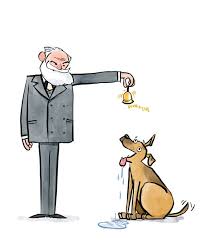
Conditioned Stimulus (CS): A Core Concept in Classical Conditioning
The Conditioned Stimulus (CS) is a central concept in behavioural psychology, particularly within classical conditioning, first systematically studied by Ivan Pavlov. While the Unconditioned Stimulus (UCS) is biologically powerful and naturally evokes a response, the Conditioned Stimulus is learned. It acquires its power through association.
Understanding the CS is essential for explaining how neutral events become emotionally charged — and how many psychological patterns, both adaptive and maladaptive, are formed.
Definition of a Conditioned Stimulus
A Conditioned Stimulus (CS) is a previously neutral stimulus that, after being repeatedly paired with an Unconditioned Stimulus (UCS), comes to elicit a response on its own.
Unlike the UCS, the CS does not initially trigger a significant response. Its effect is learned through experience.
For example:
- A bell initially produces no salivation in a dog.
- A particular room initially produces no fear.
- A specific song initially produces no emotional reaction.
However, after repeated pairing with a biologically meaningful stimulus, these neutral stimuli can acquire emotional or physiological significance.
The response produced by the CS is called the Conditioned Response (CR).
The Role of the CS in Classical Conditioning
Pavlov’s original experiments illustrate the process clearly:
Before conditioning
UCS: Food
UCR: Salivation
Neutral stimulus: Bell (no salivation)
During conditioning
Bell paired repeatedly with food (UCS)
After conditioning
CS: Bell
CR: Salivation
The bell becomes a Conditioned Stimulus because it predicts the arrival of food. Through repeated association, it acquires the ability to evoke salivation independently.
The key principle is this: the CS gains meaning by signalling the UCS.
Emotional Conditioning and the Conditioned Stimulus
In human psychology, conditioned stimuli are often environmental, relational, or symbolic cues.
For example:
- A hospital smell may trigger anxiety if previously paired with painful treatment.
- A certain tone of voice may evoke shame if associated with past criticism.
- A specific place may evoke fear if present during a traumatic event.
In these cases, the original trauma or painful experience functioned as the UCS. The environment, voice, or location became the CS.
Importantly, the CS can be subtle. It may include:
- Facial expressions
- Sounds
- Words
- Time of day
- Internal sensations
Much of emotional life operates through conditioned stimuli that have acquired significance through past experience.
The Conditioned Stimulus in Clinical Psychology
Many psychological symptoms are maintained not by the original unconditioned event, but by conditioned stimuli that continue to trigger learned responses.
For example:
- In phobias, the feared object becomes the CS.
- In post-traumatic stress, environmental reminders act as CS triggers.
- In addiction, contextual cues (such as a pub, certain friends, or stress) function as conditioned stimuli for craving.
Treatment often focuses on modifying the power of the CS.
Common therapeutic strategies include:
Extinction
Repeated exposure to the CS without the UCS reduces the conditioned response over time.
Counterconditioning
The CS is paired with a new, incompatible response (e.g., relaxation instead of fear).
Systematic desensitisation
Gradual exposure to the CS while maintaining calm physiological states.
In each case, therapy aims to weaken or transform the learned association attached to the conditioned stimulus.
Biological Basis of the Conditioned Stimulus
Neuroscientifically, once conditioning has occurred, the CS activates neural circuits that anticipate the UCS. The amygdala plays a key role in emotional conditioning, while dopaminergic pathways contribute to reward-based conditioning.
Over time, the brain responds to the prediction of the stimulus rather than the stimulus itself. This predictive coding explains why:
- A reminder can trigger fear even when no danger is present.
- A cue can trigger craving before any substance is consumed.
- A relational signal can activate attachment responses instantly.
The CS becomes neurologically encoded as a meaningful signal.
Adaptive and Maladaptive Conditioning
The Conditioned Stimulus is not inherently pathological. It is central to learning and survival.
Adaptive examples:
- Traffic lights signalling danger or safety
- A parent’s voice signalling comfort
- A school bell signalling transition
Maladaptive examples:
- Social situations triggering disproportionate anxiety
- Neutral bodily sensations triggering panic
- Harmless animals triggering phobic fear
The problem is not conditioning itself, but the persistence of outdated or exaggerated associations.
Application in Behaviour Therapy: David Kraft
In behaviour therapy, understanding the role of the Conditioned Stimulus is essential for modifying maladaptive patterns. Psychotherapist David Kraft applies conditioning principles to help clients identify and weaken conditioned triggers that maintain distress.
For example, in anxiety disorders, the focus is often on identifying the specific conditioned stimuli that provoke fear responses. Through structured exposure, strategic pairing, and reinforcement of adaptive behaviours, the conditioned link between stimulus and response is gradually restructured.
In covert sensitisation, behaviours that previously functioned as conditioned stimuli for pleasure or reward may be imaginatively paired with aversive outcomes, reducing their motivational pull. Conversely, adaptive behaviours can be paired with positive emotional reinforcement, strengthening healthier patterns.
By recognising that much psychological distress is maintained by conditioned stimuli rather than current danger, behaviour therapy works to recalibrate learned associations — reducing automatic reactivity and restoring flexibility of response.